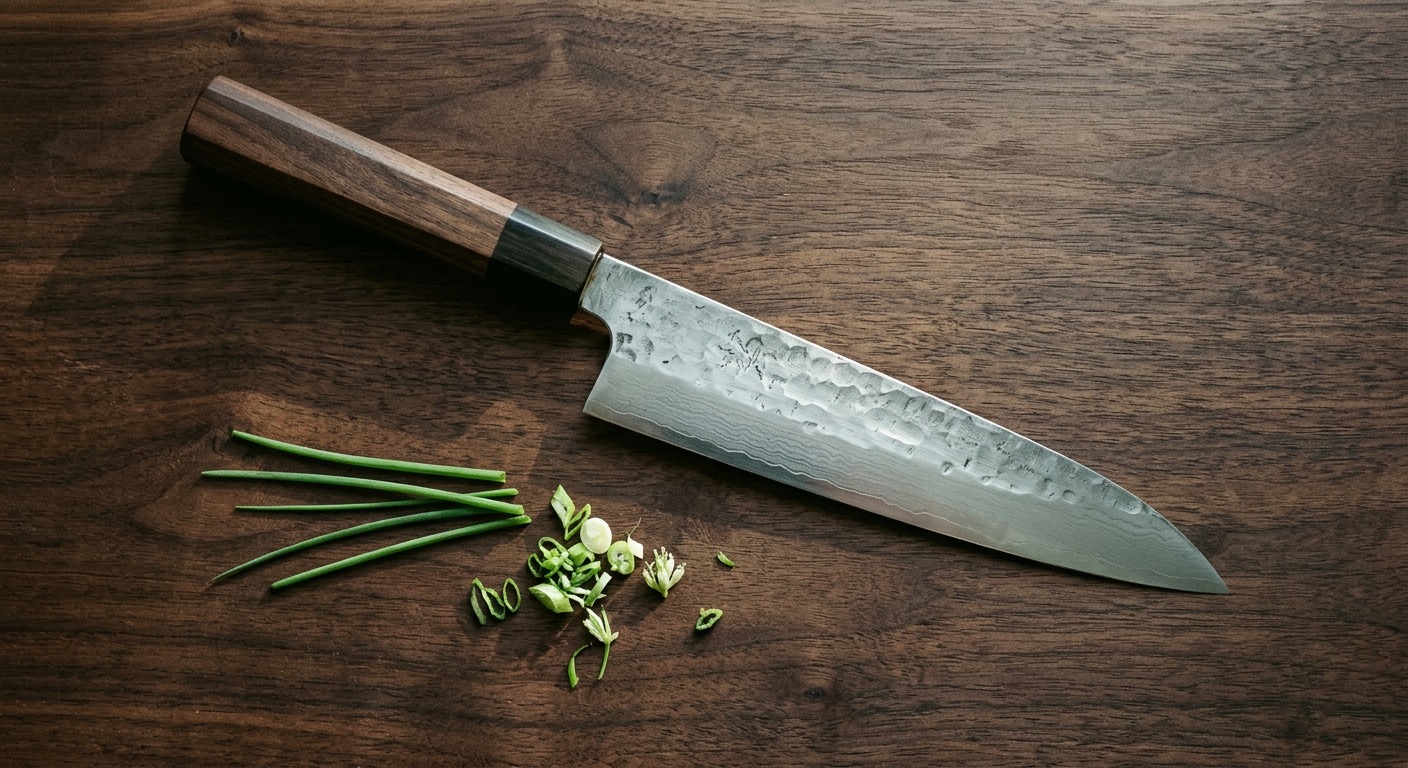
Most kitchens have at least one knife that should have been retired years ago. It slips on tomato skin, bruises herbs instead of cutting them, and asks for so much force that cooking starts to feel like a small argument. People think this is normal because the knife came in a block and the block looked official.
It is not normal. It is just common. One good knife, bought carefully and cared for properly, will outwork an entire discount set without making a speech about it.
Why Japanese steel
The conversation around Japanese knives gets mystical fast, so let us keep it plain. Harder steel holds a finer edge longer. That is the practical advantage. Most Japanese knives land around 60 to 65 HRC. Most German knives land lower. The tradeoff is that harder steel asks for a better hand. No bones. No frozen food. No twisting through something stubborn because you got impatient.
For normal cooking, that trade is worth it. Vegetables cut cleanly. Herbs stay bright instead of turning wet and sad. Protein slices instead of tears. The difference is not theoretical. It is dinner on a Tuesday.
The Global G-2
Global has made the G-2 in Niigata since 1985, and there is a reason people keep ending up here. It is light without feeling flimsy, balanced without asking for adjustment, and sharp in the way that makes you understand immediately what your old knife had been doing wrong.
Their CROMOVA 18 stainless steel is slightly softer than some Japanese knives, which is exactly why it works as a first serious knife. You still get the clarity of a Japanese edge, but with a little more forgiveness while your technique catches up.
At $165, it is not cheap. It is also not expensive once you stop comparing it to disposable things. Compare it to the knife block you replace twice in a decade and the math starts acting right.
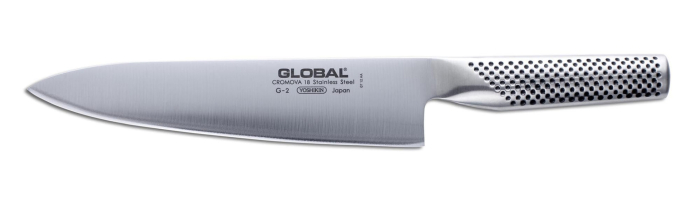
Niigata-made, seamless, light in the hand, easy to live with. The knife that quietly ends the block-set era.
Shop Global Knife →How to take care of it
The rules are boring, which is how you know they matter. Hand wash it. Dry it right away. Use wood or soft plastic under the blade. Glass, stone, and ceramic cutting boards are where good edges go to die.
Sharpen on a whetstone, not a pull-through sharpener. Pull-through sharpeners eat too much metal and leave behind a rough, hurried edge. A whetstone asks a little more of you, but it gives the knife back in full.
And learn the difference between honing and sharpening. Honing realigns the edge. Sharpening rebuilds it. One happens often and takes seconds. The other happens a few times a year and asks for patience.
Why one excellent thing
A better knife does not just cut better. It changes your willingness to cook. Onions stop feeling like punishment. Herbs get chopped because it is easy. Supper comes together with less resentment in it.
That is what you are buying. Not prestige. Not gear-culture identity. Just one object, made correctly, that makes an ordinary part of life feel more exact and a little more dignified.